TrailMaster UTV Ownership: Parts, Maintenance and Storage
- on August 20, 2021
- Categories: Articles
TrailMaster UTVs are value-tier side-by-sides, and owning one well is mostly about three habits: keep the belt and battery fresh, service on hours rather than on the calendar, and store it under cover. Do those and a TrailMaster runs for years. Skip them and you will meet the same failures every neglected small-displacement machine has.
Who makes TrailMaster, and are they any good?
TrailMaster is a US-market powersports brand whose machines are built by contract manufacturers in Asia and sold through North American dealers and distributors — the same model behind most value-tier side-by-sides.
Honestly assessed: they are not Polaris or Kawasaki, and they are not priced as if they were. You get a mechanically simple machine with a real roll cage, a bed and seat belts for a fraction of premium money, and you give up refinement, long-travel suspension and a deep dealer network. For property work, hunting access and second-machine duty that trade is usually right. For high-speed dune or desert riding it is not — buy a premium sport model.
If you are choosing between models rather than reading about ownership, our Challenger vs Taurus model guide walks the ladder in detail. New to the category entirely? Start with what a UTV is.
Parts and support
Buyers underestimate this, and it decides whether a value-tier machine still works in year four. Sort out three things:
- •Who supplies parts. Buy from a seller that stocks consumables — belts, pads, batteries, filters, cables, plastics — not a marketplace listing that disappears.
- •Your model and VIN, written down. TrailMaster runs several closely related model lines and revisions. The correct belt for a Challenger 200 is not the correct belt for a Taurus 450. Order by VIN, not by memory.
- •The manual. Download it and keep a copy off the machine. Torque values, tire pressures and service intervals are all in there.
Maintenance intervals worth keeping
Service by engine hours where the machine has an hour meter, and by season where it does not. These are typical intervals for small-displacement side-by-sides; always defer to your model's manual.
| Item | Typical interval | Notes |
|---|---|---|
| Engine oil and filter | Every 50–100 hours or once a season | Do the first change early, at the end of break-in |
| Air filter | Inspect every ride in dust, clean or replace regularly | A clogged filter is the cheapest way to shorten an engine's life |
| Drive belt | Inspect seasonally, replace on wear or glazing | Carry a spare; without one a broken belt ends the day |
| Brakes | Inspect pads and fluid seasonally | Check all corners, including the parking brake |
| Tire pressure | Check monthly and before long use | Low-pressure gauge, not a car gauge |
| Fasteners | Retorque after the first few hours, then seasonally | New machines settle; suspension and cage bolts loosen first |
| Grease points | Seasonally, more often in mud or water | Steering, suspension pivots and driveshaft where fitted |
| Cooling | Check the radiator and clean debris regularly | Mud packed in fins is a common overheating cause |
The wear items that actually fail
The failure list is short and predictable: drive belts, batteries, brake pads, tires, cables and light assemblies. Electrical gremlins usually trace to a corroded ground or a connector that sat wet.
Two habits prevent most of it. Wash mud off the radiator and out of the suspension after wet use, and put the battery on a maintenance charger when the machine sits. Batteries that die early almost always died from sitting discharged, not from use.
Accessories: what gets used and what does not
After the first season, owners consistently reach for the same short list — and leave the rest on the shelf.
- •Gets used: a windshield, a fitted cover, a decent set of tires, a winch if you work alone, a bed liner or mat, and a maintenance charger.
- •Sometimes: a roof or cab enclosure if you work through winter, mirrors, and a light bar if you actually operate after dark.
- •Rarely worth it first: cosmetic wheels, audio, and big suspension upgrades. Spend that money on tires and a cover instead.
If your machine is mainly a work vehicle, the priorities shift again toward bed capacity and gearing — our guide to the best UTV for farm work covers that.
Off-season and winter storage
A stored machine deteriorates faster than a used one. For a gas model: fill the tank and add stabilizer, run it long enough to reach the carburetor or injectors, change the oil before storage rather than after, remove or tender the battery, set tire pressures, and cover it in a dry spot off bare ground.
For an electric model, storage is about the pack rather than fuel. Store at a partial charge as the manual specifies, keep it out of hard freezes where possible, and check the charge periodically over winter rather than leaving it untouched until spring.
Current TrailMaster side-by-sides


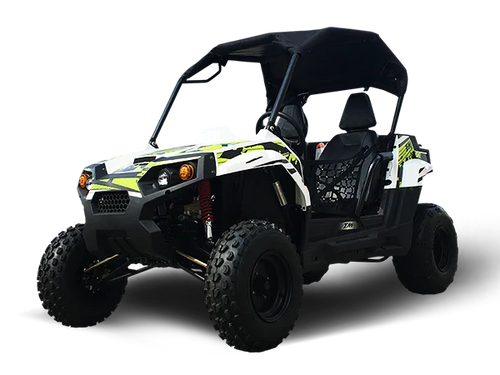
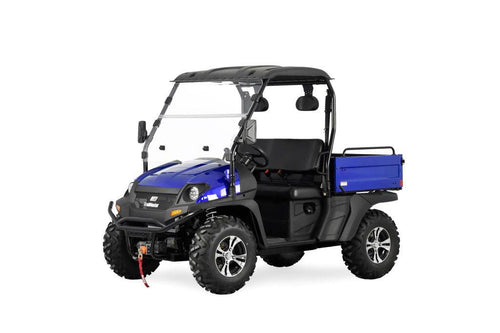
The line spans two-seat utility machines, four- and six-seat models with flip seats and dump beds, and electric versions. If children will ride or ride along, read our kids side-by-side safety guide first.
Frequently asked questions
Who makes TrailMaster UTVs?
TrailMaster is a US-market powersports brand. Its machines are produced by contract manufacturers in Asia and sold through North American dealers and distributors, which is how most value-tier side-by-sides reach the market.
Are TrailMaster UTVs any good?
For property work, hunting access, ranch chores and second-machine use, yes — they are simple, capable and priced well below premium brands. For high-speed dune or desert riding they are the wrong tool, and a premium sport model is the honest answer.
How often does a TrailMaster UTV need servicing?
Plan on oil and filter every 50 to 100 hours or once a season, with air filter, brake, belt, tire and fastener checks on the same rhythm. Follow your model's manual over any general figure.
What parts fail first on a value-tier UTV?
Drive belts and batteries, followed by brake pads, tires, cables and light assemblies. Keeping a spare belt and using a maintenance charger prevents most lost days.
Does TrailMaster make an electric UTV?
Yes. The lineup includes battery-electric models running higher-voltage systems alongside the gas machines. Ownership differs mainly in storage and charging rather than in maintenance schedule.