Kids Side-by-Side Safety: Features, Fit and Ground Rules
- on June 06, 2023
- Categories: Articles
A good kids side-by-side is one a child can physically operate and cannot easily be thrown out of: a welded roll cage, an over-the-shoulder harness, nets or doors, an adjustable throttle limiter, and a remote kill switch in an adult's hand. Helmets on every rider, every ride. Never more people than there are belted seats.
A youth side-by-side is generally a safer way for a child to ride than a quad. The rider sits inside a cage rather than on top of the machine, is held by a belt instead of by grip and body weight, and steers with a wheel and pedals rather than by shifting weight. None of that is automatic. It depends on the equipment, on the machine fitting the child, and on an adult enforcing rules.
The safety features that actually matter
| Feature | Why it matters | What to look for |
|---|---|---|
| Full roll cage | Puts structure between the rider and the ground in a tip-over | Welded steel tubing, padded bars, side and brush guards |
| Over-the-shoulder belts | A lap belt alone lets the upper body fold forward and out | Four- or five-point harness that adjusts to a small torso |
| Nets or doors | Arms and legs reach outside the cage in a slide or roll | Full-height nets or hard doors, not one grab strap |
| Throttle limiter | Caps top speed while skills build | An adjustable stop on the gas pedal |
| Remote kill switch | An adult can shut the engine down from outside | A key fob remote, tested before each ride |
| Hydraulic disc brakes | Consistent stopping when hot, wet or loaded | Front and rear discs, plus a parking brake |
Fit comes before features
Age ratings are shorthand, and children of the same age differ by a foot in height. Run the fit check with the child seated, belted and the engine off: shoulders against the seat back with the harness snug; both feet able to press the brake fully; a clear view over the hood; hands staying on the wheel through a full turn; rider and passenger inside the stated weight capacity.
| Class | Maker age guidance | Practical notes |
|---|---|---|
| Kids mini kart | Roughly up to 10 | Pedals adjust in to about 26 inches, five-point harness |
| Mid-size youth | 10 and up | Seat typically adjusts across 32 to 39 inches, throttle limiter |
| Full-size UTV | 13 to 16 and up | Adult cabin; a smaller teen will not reach the pedals |
One seat, one rider
This rule is broken often and sits behind a large share of serious youth injuries. A single-seat kart or single-rider quad carries one person: a passenger changes where the weight sits, blocks the rider from moving, and has nothing to hold. In a two-seat machine, every occupant needs a belted seat, back against the seat, feet flat on the floorboard, hands inside the cage. A child whose feet do not reach the floor should not ride as a passenger either, because the legs have nowhere to brace.
Gear, every ride, including the short ones
- •Helmet. DOT-rated, sized so the forehead skin moves with it. Replace it after any impact.
- •Eye protection. Goggles or a full-face shield. Cages do not stop rocks and branches.
- •Gloves and boots. Full-finger gloves and boots covering the ankle. Sneakers slip off pedals.
- •Clothing. Long sleeves and pants; tie back long hair and lose drawstrings near moving parts.
Whether a helmet is legally required inside a side-by-side varies by state, and some rules exempt vehicles with a cage and belts. That is a legal technicality, not safety advice: belts and a cage protect the body, but nothing in the machine protects a head that hits the cage.
Adult rules that stick
- •An adult stays outside the machine holding the remote kill switch until skills are proven.
- •Set the throttle limiter to its lowest setting on day one and raise it over weeks, not minutes.
- •Mark a visible boundary. Open, flat, familiar ground first; hills, water and ruts much later.
- •No public roads. Youth off-road machines are not street legal, and pavement changes how they handle.
- •Teach the shutdown before the throttle: kill switch, brake, key, until it is automatic.
The five-minute pre-ride check
- •Kill switch. Start the engine and shut it off with the remote before anyone gets in.
- •Brakes. Firm pedal, and the machine stops on a short roll test.
- •Tires. Pressure to the sticker, no sidewall cuts.
- •Belts and cage. Latches click, webbing undamaged, bolts tight. Re-torque after the first hour of use.
- •Throttle and fluids. Throttle snaps closed on its own; oil and fuel checked; nothing dripping.
Youth machines built around these features


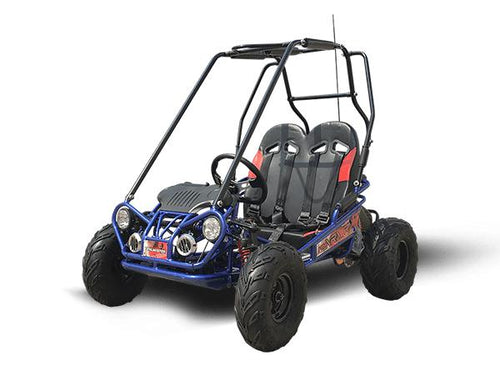
Trailmaster Eagle Mini XRX/R+ Go Kart with Reverse Best Seller. Up to 10 years Old
Five-point harness, remote kill, adjustable pedals
$1,549$1,849
View
TrailMaster Cheetah 6 Youth Go-Kart - 163cc 5.5HP Engine
Four-point over-shoulder belts, governor, remote kill
$1,899$2,279
View
Trailmaster Cheetah 8 Off Road UTV / Go Kart / Mid Size Youth ages 10 and up/ coil over shocks
Ages 10 and up, throttle limiter, padded full cage
$2,649$3,179
ViewPrices shown at time of writing. These ship crated and need assembly and a full bolt check before the first ride.
Start slower than feels necessary
Most youth off-road injuries trace to a machine too fast or too big for the rider, a passenger who should not be aboard, or a helmet left in the garage for a short lap of the property. All three are decided before the engine starts. Still choosing between machine types? Our comparison of quads and side-by-sides covers where each fits; for a child, the cage and the belts usually decide it.
Frequently asked questions
What safety features should I look for in a kids side-by-side?
A welded full roll cage, over-the-shoulder four- or five-point belts, nets or doors, an adjustable throttle limiter, a remote engine kill switch, hydraulic disc brakes, and a seat and pedals that adjust to the child.
Do kids have to wear helmets in a side-by-side?
State rules vary, and some exempt vehicles with a roll cage and seat belts. Regardless of local law, a DOT-rated helmet should be worn by every occupant on every ride.
What safety gear should kids wear when riding an ATV or side-by-side?
A fitted DOT-rated helmet, goggles or a full-face shield, full-finger gloves, boots that cover the ankle, and long sleeves and pants.
Can a child ride as a passenger on a single-seat go-kart or quad?
No. Single-rider machines carry one person. A passenger changes the weight balance, stops the rider from moving, and has nothing to hold or brace against.
What age can a child drive a side-by-side?
Makers commonly rate mini karts up to about age 10, mid-size youth machines from 10 up, and full-size UTVs from 13 to 16 up. Fit matters more than age.