What Age Can a Kid Drive a Side-by-Side? A Fit-First Guide
- on August 31, 2026
- Categories: Articles
Most youth side-by-sides are built for ages 10 and up, and a couple of two-seat buggies start around 5. But age is the weakest way to choose one. What actually decides whether a child can drive the machine is whether their foot reaches the pedal with their back flat against the seat. Measure that first, then shop.
Every guide to kids’ side-by-sides opens with an age chart. That is not what we ask when a parent calls. We ask how tall the kid is — two children the same age can be five inches apart, and five inches is the difference between a rider who can brake hard and one who cannot.
The federal youth-ATV rule does not cover side-by-sides
You will see the CPSC youth categories quoted everywhere — Y-6, Y-10, a transitional class for age 14 and up. Those apply to ATVs, and federal law is specific: an ATV is a motorized off-highway vehicle on three or four wheels, with a seat designed to be straddled and handlebars for steering. A side-by-side has bucket seats and a steering wheel, so those youth-ATV age categories are not the rule that governs it.
What governs it instead is the manufacturer’s stated age for that exact model, plus your state’s rules on where a minor may ride and with what supervision. Those vary. Read them on your state agency’s own site, not a dealer’s blog — including ours.
The measurement that matters: pedal to seat back
TrailMaster publishes a pedal-to-seat-back range on most of these machines — pedal face to seat back at full adjustment. Sit your child on a dining chair, back flat against it, and measure from the seat back to their heel with the leg almost straight. That number has to land inside the machine’s range — ideally the lower half, so there is room to grow.
Kids and youth side-by-sides we have on the floor right now
| Model | Engine | Maker’s stated age | Driver fit, pedal to seat back | Price |
|---|---|---|---|---|
| TrailMaster Eagle Mini XRX+ | 212cc | 5 to 10 | Adjustable seat and pedals | $1,249 |
| TrailMaster Eagle Mini XRX/R+ | 212cc | Up to 10 | 30″–35″, pedal 3″ or 6″ shorter | $1,549 |
| TrailMaster Eagle Mid XRX | 212cc | 8 to 12 | 31.5″–40.5″ | $1,699 |
| TrailMaster Eagle Mid XRX/R | 212cc | 10 to 13 | 31.5″–40.5″ | $2,299 |
| TrailMaster Cheetah 8 | 208cc | 10 and up | 32″–38″ | $2,649 |
| TrailMaster Challenger 200 | 168.9cc | Youth and adult | 38″–43″ | $3,299 |
| TrailMaster Challenger 200X | 168.9cc | Youth and adult | 36″–43″ | $3,849 |
| TrailMaster Challenger 200U | 168.9cc | 16 and older | Not published | $4,299 |
All eight are two-seat gas machines. Prices, ages and fit ranges read from each product’s own listing and spec table on August 31, 2026. Where a listing gives two different figures, the spec table value is used.
The age labels contradict each other, and that is the point
Look at the Mid XRX. Its title says ages 10 and up. Its description says 8 to 12, then a paragraph later calls it the right size for riders 8 to 14. Three numbers, one machine, one manufacturer — and that is not unusual in this segment. Nobody publishes a rider height, so age becomes shorthand for size and the shorthand drifts. Read the fit column instead: a tall 8-year-old fits a Mid XRX, and a small 11-year-old will not reach the pedals on a Challenger 200, which starts at 38 inches.
Why searching “kids side by side” returns mostly toys
Type that phrase into a search bar and you get a wall of battery ride-ons next to $3,000 machines with roll cages. The line between them is drawn by regulators, not marketing: CPSC treats anything capable of more than 5 mph as more likely to be used off-highway, and therefore a vehicle rather than a children’s ride-on toy — which it describes as being for flat, smooth surfaces like driveways and groomed lawns.
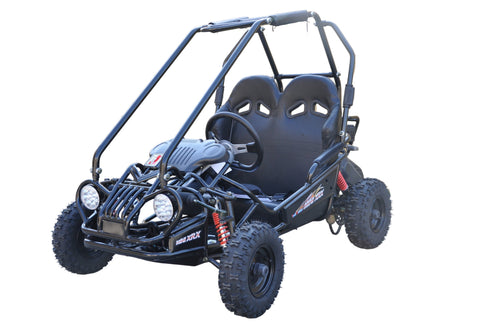
A ride-on toy has a plastic body, a sealed battery and a top speed you can walk beside. Everything in the table above has a steel roll cage, disc brakes, a harness and a real engine. If a listing will not name a displacement or a brake type, it is a toy — which is why parents type “gas powered” into the search box in the first place.
Two seats means a passenger, and that changes what you buy
- •The passenger seat has its own harness. If the belt will not tighten on your smaller child, they do not ride. Fit the driver with room to spare before you think about a passenger.
- •The Cheetah 8 goes out to 38 inches, so an adult up to about 5′4″ can drive it — useful, because you want to test it yourself.
Set the throttle limiter before the first ride
Every machine in the table has one. On the Challenger 200 it brings top speed down to around ten miles an hour. Set it there on day one and leave it — it is a screw on the pedal or the cable and it takes two minutes. The Mini XRX/R+ also has a remote engine kill, which belongs in your pocket, not in the box.
What actually shows up at your door
These arrive crated and roughly 90 to 95 percent assembled: fit the roll bar, mount the steering wheel, connect the battery, add fuel. Budget an afternoon and basic hand tools. The battery is what catches people out — it comes dry or disconnected, and a machine that will not crank on day one is almost always a battery nobody charged. The Cheetah 8 and the Mid XRX/R both have a 95% pre-assembled listing. Our warehouse is in Garland, Texas; the technical line is 877-667-6289.
Frequently asked questions
What age can a kid drive a side-by-side?
It depends on the machine. Manufacturer age statements in this class run from around 5 to 10 on the smallest two-seat buggies up to 16 and older on utility models. Fit matters more than the number: the child has to reach the pedal with their back against the seat.
Is a side-by-side good for a 10 year old?
Ten is the most common manufacturer minimum in this class. A 10-year-old of average height fits a TrailMaster Cheetah 8 at 32 to 38 inches pedal to seat back. A smaller 10-year-old is better off on a Mini XRX/R+.
What size side-by-side for a 7 year old?
The mini class, not a full youth machine. The Mini XRX+ is stated for ages 5 to 10, and the Mini XRX/R+ adjusts from 30 to 35 inches pedal to seat back, with the pedal able to move 3 or 6 inches closer.
Can a 12 year old drive a side-by-side?
Yes, on a youth machine. A 12-year-old sits at the top of the range for the mid-size karts and at the bottom of the range for a Challenger 200, which starts at 38 inches. Where they may legally ride is a separate question set by your state.
What is the difference between a kids side-by-side and a youth go-kart?
Very little, and the listings say so — the Cheetah 8 is listed as a UTV / go-kart. Both are two-seat, roll-caged, harnessed off-road machines. The Challenger class adds a live rear axle, an automatic transmission with reverse and a full lighting package.
Are kids side-by-sides gas powered or electric?
The genuine youth machines in this price range are gas. Electric at this size is mostly ride-on toys, plus a few real single-seat karts. Two seats and a roll cage under $4,000 means gas.
Does my child need a license to drive a side-by-side?
Not on private land. On public land, trails or any road crossing, operator age, supervision and certification rules are set by your state and vary widely. Check your state's own parks, wildlife or motor vehicle agency before riding anywhere but your own property.
Battery machines run far quieter, which matters with young passengers — see our electric UTVs.
Three that cover the range


Browse our powersports range for kids and teens, the youth go-kart buggies, or step up to the full side-by-side lineup. Not sure where your child lands in a fit range? Call 877-667-6289 and read us the measurement.
Written by the Motobuys team, Garland, Texas. Specifications and prices verified against our live product catalog on August 31, 2026. Related reading: what size go-kart for a kid.