Are Chinese ATVs and Go-Karts Reliable?
- on October 21, 2026
- Categories: Articles
Reliable enough for what most buyers use them for — property riding, campground loops, youth riding, occasional trails — and not reliable enough to replace a Honda or Polaris on a working ranch or in competition. The engines are simple and durable. What fails is almost always a belt, a battery, a brake adjustment or a fastener that was never torqued correctly during assembly.
Nearly every published answer on this question is about dirt bikes. Four-wheelers behave differently, so this is the four-wheeled version, written from what a dealer actually sees. The two-wheeled side is in our honest answer on Chinese dirt bike reliability.
What is different about ATVs and go-karts
Youth ATVs from 107cc to 125cc use the same air-cooled automatic single that has been built in volume for decades. There is very little on them to go wrong: no liquid cooling, no fuel injection, no clutch to burn. With fresh fuel, a charged battery and the chain and brakes kept adjusted, these are the most trouble-free machines in the budget segment.
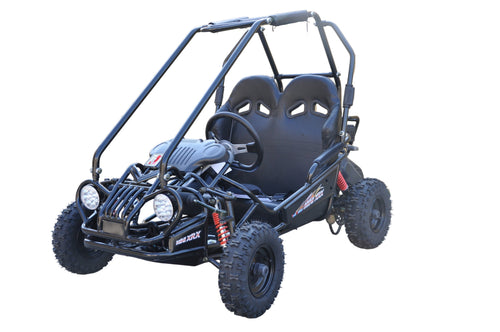
Adult ATVs and most karts above roughly 150cc move to a CVT belt with a forward-neutral-reverse gearbox. That belt is the main consumable and the most common reason a machine stops moving. Smaller karts use a torque converter and chain instead. Kart frames add tie rods, cage and seat bolts and rear axle bearings — none of it exotic, all of it prone to loosening in the first few hours, and a loose tie rod end is a safety item.
What actually goes wrong, in the order we see it
- •Assembly errors. Most first-week problems trace to the crate, not the factory: a loose axle nut, an unseated caliper, a pinched throttle cable, a battery installed without being charged.
- •Batteries. The battery shipped with a budget machine is the weakest component on it. Charge it fully before first start and expect to replace it sooner than on a Japanese machine.
- •CVT belts. A belt run slipping, overloaded or through standing water will not last. Inspect it, keep a spare, do not tow with the machine.
- •Carburetor settings. Carbureted units often arrive jetted for sea level and need idle and mixture adjustment, especially at altitude.
- •Brakes. Drum and mechanical disc setups need adjusting once cables and pads bed in, usually within the first couple of hours.
What you get at each price level
| Class | Current prices | What to expect | Main maintenance item |
|---|---|---|---|
| Youth ATV, 107–125cc | $659–$1,279 | Air-cooled automatic, electric start | Chain, brakes, battery |
| Adult ATV, 150–250cc | $1,499–$2,979 | CVT with reverse, carbureted or EFI | CVT belt |
| Youth go-kart | $1,129–$1,949 | Torque converter or CVT, speed limiter | Chain, tie rods |
| Adult kart, 170–200cc | $2,299–$4,299 | CVT with reverse, roll cage, many EFI | Belt, cage and seat bolts |
| 300cc buggy or kart | $4,199–$6,999 | EFI, water cooled, top of the segment | Belt, coolant, bearings |
Where a premium brand is the right answer
If the machine is a work tool — feeding livestock daily, pulling an implement, running hours at a time in heat — buy a Honda, Yamaha, Can-Am or Polaris. Cooling capacity, suspension travel, dealer network and resale justify the price. The same goes for riding fast on rough trails, where suspension quality is a safety matter rather than a comfort one.
The case for our machines is narrower and real: youth riding, where a $700 quad that gets outgrown is the sensible purchase; property and campground use measured in hours rather than days; a first go-kart for a teenager. Within that, they hold up. Browse ATVs and 4-wheelers and off-road go-karts and buggies.
The cons worth knowing before you order
- •Assembly is required on most units, and the warranty requires a qualified mechanic or dealer to do it. Some models ship 95% pre-assembled — worth paying for.
- •Resale is low. Budget these as consumables, not as assets you recover value from.
- •Not for racing or jumping. That use is outside warranty coverage and the frames are not built for it.
- •Component quality is mixed at the bottom of the range — tires, batteries and plastics are where cost comes out.
- •Parts are the long-term question. We answer it in can you get parts for a Chinese dirt bike; the same platform logic applies to quads and karts.
How to make one last
Re-torque everything at two hours, then again at ten. Change the oil early, because the first fill carries assembly debris. Keep a spare belt, or a chain and master link, on the shelf. Watch tire pressures. Store it with fuel stabilizer. Coverage is on our warranty page: engine 12 months on TrailMaster and 6 on other brands, parts 6 and 3 months, parts and diagnostic guidance but not labor.
Four machines that fit these uses


Frequently asked questions
Are Chinese ATVs and go-karts reliable?
For property riding, youth use and occasional trails, yes — the engines are simple and durable. For daily ranch work or racing, no. Most failures are assembly errors, batteries, CVT belts and brake adjustment, not engine faults.
What breaks first on a Chinese go-kart?
Usually the belt or the fasteners. CVT belts are the main consumable above roughly 150cc, and tie rods, seat bolts and cage bolts loosen in the first few hours. Re-torque at two hours and keep a spare belt.
How long does a Chinese ATV last?
That depends on maintenance and use far more than on brand. Kept on fresh fuel, with oil changed early and fasteners checked, a youth quad commonly serves until the rider outgrows it. Left with stale fuel over winter, it will not.
Are these ATVs and go-karts safe for kids?
With the right size machine, supervision, a helmet and the speed limiter set, yes. Size matters more than brand: a quad a rider cannot reach the controls on is unsafe whoever built it. Check seat height and recommended age on each listing.
Do Chinese ATVs and go-karts come with a warranty?
Yes. Engine coverage is 12 months on TrailMaster and 6 months on other brands; parts coverage is 6 and 3 months. It covers parts and diagnostic guidance, not labor, and requires professional assembly.