Are 3 Wheel Scooters Street Legal? What License You Need
- on September 16, 2026
- Categories: Articles
Yes — a gas trike scooter built with lights, mirrors, turn signals and a VIN is street legal in most of the country once you register it. The harder question is which license you need to ride it. Two things decide that: whether you straddle the seat, and how big the engine is. Wheel count barely matters.
Search this question and every result ends in the same four words: check your local laws. That is not an answer. Here is what the classification actually turns on, two states that land on opposite sides of it, and what the paperwork costs.
Two completely different machines get called “3 wheelers”
This is the mistake underneath almost every wrong answer online:
- •Autocycle / reverse trike. Two wheels in front, one in back. You sit in it, not on it — a bucket seat, a seat belt, sometimes a steering wheel. A Polaris Slingshot is the one everybody pictures.
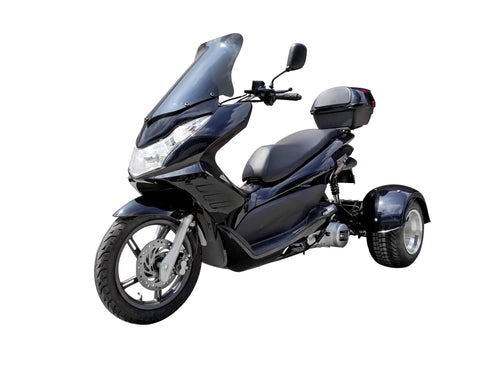
- •Trike scooter. One wheel in front, two in back. Handlebars, a saddle you throw a leg over, a twist throttle. This is the Ruckus-style machine people shop for at this price, and it is what we stock.
The two are regulated differently, and the rules were written around seating position rather than wheel count. Apply a rule drafted for the first shape to the second and you get a confident, wrong answer. It happens constantly.
New York: the easy rule does not cover trike scooters
New York publishes a page on three-wheeled motor vehicles, and its definition is precise. A three-wheeled motor vehicle is a vehicle with two wheels in the front and one wheel in the rear, a steering mechanism, and seating that does not require the operator to straddle or sit astride. Those vehicles are classified as motorcycles — they must be registered and insured, you must wear a DOT-compliant helmet and ANSI Z-87 eye protection — but a plain Class D automobile license is enough to operate one. No motorcycle class needed.
So if your state has a special three-wheel category, read the definition before assuming you qualify — count the wheels on each axle and check whether the text mentions straddling.
California: the third wheel really does remove the endorsement
California writes it the other way round, and this is where trike scooters genuinely win. The Highway Patrol’s summary of the Vehicle Code says a motorcycle is a motor vehicle with a seat or saddle, designed to travel on not more than three wheels, whose motor displaces more than 150 cubic centimeters. Below that displacement the same machine is a motor-driven cycle. Then comes the part that matters:
- •Two-wheeled motorcycles and two-wheeled motor-driven cycles require an M-1 endorsement.
- •Three-wheeled motorcycles and three-wheeled motor-driven cycles require only a Class C driver license — the ordinary car license.
- •A DOT-compliant helmet is required either way.
So in California the extra wheel is worth an entire license class: a rider who cannot pass a two-wheel skills test, or does not want to, can ride a 150cc trike on the license already in their wallet. In New York the same machine sits outside the shortcut. Same vehicle, opposite outcome — which is why this question has no single national answer.
Two states, quoted from their own agencies. Do not read either as advice about the other 48 — call your DMV, give them the engine displacement and the seating position, and ask which license class and registration category apply.
Engine size is the second lever, and 50cc is the line
Displacement runs on its own track, independent of wheel count. Many states have a moped or motorized-bicycle category with lighter licensing, registration and insurance rules, and the cutoff usually sits at or just under 50cc. California defines its moped category partly by output and speed instead — under 4 gross brake horsepower, automatic transmission, and not capable of more than 30 mph on level ground.
That is why our own listings say different things about licensing. The 50cc Q6 listing notes that many states do not require a motorcycle license, registration or insurance under 50cc. The 150cc Trifecta listing says flatly that it requires registration and a motorcycle endorsement in most states. Both are accurate — the engine is what changed. On the 50cc shelf specifically, we went through what a 49cc engine changes about licensing in more detail.
Every 3 wheel scooter we currently stock, and what it costs
Six three-wheelers are live on the site, all Ice Bear, all one wheel up front and two at the back. Prices and specs are read from the live listings as of September 16, 2026.
| Model | Engine | Transmission | Seat height | Price | Compare at |
|---|---|---|---|---|---|
| Ice Bear Maddog PST50-19N | 49.5cc (139QMB) | Automatic CVT | 22″ | $2,199 | $2,639 |
| Ice Bear Mojo PST50-1Z | 50cc (139QMB) | Automatic CVT | 30.71″ | $2,249 | $2,699 |
| Ice Bear Q6 PST50-17 | 50cc (139QMB) | Automatic CVT | 30.7″ | $2,399 | $2,999 |
| Ice Bear Trifecta PST150-2 | 150cc (157QMJ) | Automatic CVT | 29.5″ | $2,599 | $3,119 |
| Ice Bear Q6 PST150-17 | 150cc (157QMJ) | Automatic CVT | 30.7″ | $2,699 | $3,239 |
| Ice Bear Maddog PST150-19N | 150cc (157QMJ) | Automatic CVT | 22″ | $2,699 | $3,239 |
Three things worth reading off that table. The whole shelf is automatic — no clutch, no gear lever, which is half the appeal. The gap between the 50cc and 150cc classes is a few hundred dollars, so this is a licensing decision far more than a budget one. And seat height splits the range hard: the Maddog sits at 22″ on a lowered frame while the Q6 and Trifecta sit around 30″. If you are short in the leg, that matters more than the engine.
Load ratings differ too: the Maddog 150 is rated to 355 lb, the Q6 150 and Trifecta to 441 lb, the 50cc Maddog and Mojo to 220 lb. Two-up riders should check that line first. The rest of the range sits on the scooters, mopeds and trikes page, and the trikes are grouped under Ice Bear trikes.
“CARB approved” is not the same as “street legal”
We field this one on the phone constantly, and it costs people money. CARB certification is an emissions approval governing whether a machine may be sold into California at all. It says nothing about whether your DMV will plate it.
Street legality is a separate three-part test: the road equipment (headlight, tail and brake light, turn signals, mirrors, horn, DOT tires), a VIN and an origin document, and registration in whatever class your state assigns. A machine can be CARB approved and still unregisterable where you live, or fully road-equipped and still blocked from California on emissions. Different gates.
The paperwork that actually stops people at the DMV
A new vehicle has no title yet. What it has is an MCO — a Manufacturer’s Certificate of Origin, sometimes written MSO. Your DMV converts it into a title and a plate. Without it you own a machine you cannot register, and a replacement after the fact is slow.
Most states also want the MCO endorsed by the selling dealer first. We list that as its own line item, Dealer Endorsed MCO/Title Processing, at $39 — not part of the sticker price, and the single most common thing road-going buyers forget to add. If the machine is staying on private property, you do not need it.
Bring the MCO, the bill of sale, your ID and proof of insurance — and ask the clerk which class the vehicle falls into before you hand anything over. Unwinding a wrong category later is far worse than asking now.
What actually turns up in the crate
These arrive crated and partly built, which nobody in the search results mentions. On the Maddog trikes the owner fits the wheels, the fenders, the handlebars and the mirrors. None of it is difficult, but it is real work with real tools — and the road-legal parts you are installing include the mirrors and the lighting. Fit them properly or your first inspection goes badly.
Two things catch first-time owners. The battery comes dry or disconnected and must be serviced and charged before the machine will start — our number one first-week phone call, and not a fault. And a trike steers nothing like a two-wheeler: it does not lean, so you push the bars through a turn and corner slower than instinct says. Find an empty lot for the first hour. If you would rather not build it yourself, assembly is a paid option, and our Garland, Texas warehouse can talk you through the rest at 877-667-6289.
Three trike scooters to start with
All three are active and available to order as of September 16, 2026:


Frequently asked questions
Is a 3 wheel scooter for adults street legal?
In most of the country, yes, provided it carries road equipment — headlight, tail and brake light, turn signals, mirrors, horn and DOT tires — and you register it with the MCO. The variable is not legality but which license class your state assigns, which depends on engine displacement and on whether you straddle the seat.
Is a 3 wheel moped street legal?
Usually, and the 50cc class is often the easier one. Many states run a moped or motorized-bicycle category with lighter licensing, registration and insurance rules, and the cutoff typically sits at or just under 50cc. California defines its moped category partly by output and speed instead — under 4 gross brake horsepower, automatic, and not capable of more than 30 mph on level ground. Check how your own state draws the line.
Do you need a license to drive a moped under 50cc?
It depends entirely on the state, and the honest answer is that it splits roughly down the middle. Some states require no motorcycle class for a sub-50cc machine, some require a moped-specific permit, and some require the full endorsement anyway. Ask your DMV using the displacement figure from the listing, not the word moped.
How much is a 3 wheel motorcycle?
Trike scooters at Motobuys run $2,199 to $2,699 as of September 16, 2026, covering both the 50cc and 150cc classes. Full-size touring trikes from the major manufacturers are a different market and cost several times that.
What is the cheapest trike motorcycle?
The cheapest three-wheeler we list is the Ice Bear Maddog PST50-19N at $2,199, a 49.5cc automatic with a 22-inch seat height. Its compare-at price is $2,639.
What do you call a 3 wheel motorcycle?
Both shapes get called trikes, which is where the confusion starts. A machine with one wheel in front and two in back that you straddle is a trike or trike scooter. A machine with two wheels in front, one in back and a seat you sit in rather than on is usually called an autocycle or a reverse trike. The licensing rules differ between them.
Who makes trike motorcycles?
In this price segment the trike scooters are almost all Ice Bear, which is the only brand we carry in the category. Above it, the touring trike market is Harley-Davidson, Can-Am and aftermarket conversions of full-size motorcycles.
Not sure which class your state will use? Call 877-667-6289 with the displacement you are considering — we can tell you what paperwork buyers in your state come back asking for. Or browse scooters, mopeds and trikes and scooter prices by engine size.