Are UTVs and Go-Karts Street Legal? What Actually Decides It
- on September 14, 2026
- Categories: Articles
Almost never from the factory. A side-by-side, go-kart or mini jeep is built and certified for off-road use, so it carries no federal motor-vehicle certification. Whether you can register one for the road is decided by your state, not by the lights and mirrors you bolt on. Here is what actually controls it.
The equipment list everybody publishes is the wrong answer
Search this question and you get the same article eight times. Add turn signals. Add mirrors. Add a horn, DOT tires, a windshield, a license plate bracket. RideNow Powersports published that exact checklist in August 2025. UTV Driver runs a state-by-state compilation dated February 2025. Both are useful, and neither one tells you why the list exists or what happens when your machine already has most of it.
Because ours already do. Here is what ten of the four-wheeled machines on our shelf carry, read off each listing’s own spec sheet on 14 September 2026.
| Model | Price | Engine | Seats | Road equipment named on the listing |
|---|---|---|---|---|
| Vitacci GR-2 Safari Series 3 | $2,299 | 125cc | 2 | Lights, turn signals, horn, seat belts, windshield |
| Mini-Jeep GK6125A Series 2 | $2,299 | 125cc | 2 | Lights, turn signals, horn, windshield, speedometer |
| CRT Moto DF200GKA Deluxe | $2,999 | 168.9cc | 2 | Headlight, turn signals, horn, light bar |
| TrailMaster Cheetah 200X | $3,399 | 168.9cc | 2 | LED headlight, brake lights, turn signals, side mirrors, windshield |
| TrailMaster Challenger 200X | $3,849 | 168.9cc | 2 | Windshield, side mirrors, turn signals, horn, speedometer |
| TrailMaster Challenger 200EUX | $5,199 | 168.9cc | 2 | Full DOT light package, LED headlights, turn signals, horn, mirrors, windshield |
| TrailMaster Taurus 200GX | $5,999 | 177.3cc | 4 | Head, tail and brake lights, turn signals, parking brake, speedometer |
| TrailMaster Challenger 4-300X EFI | $6,699 | 300cc | 4 | Headlights, tail lights, blinkers, brake lights, horn, mirrors, windshield |
| TrailMaster Taurus 450-U | $8,699 | 390.8cc | 2 | Hi/Low LED headlights, turn signals, side mirrors, horn (windshield optional) |
| TrailMaster Panther 550 | $10,099 | 498.6cc | 3 | Headlights, turn signals, center and side mirrors, horn, windshield |
Prices and equipment read from each product listing on 14 September 2026. Not one of these ten listings claims the machine is street legal. Two of them say the opposite in the product title.
Look at the Challenger 200EUX. Full DOT light package, LED headlights, turn signals, a horn, side mirrors, a windshield, four-point belts and a parking brake. By the checklist, it is done. It is still an off-road machine, and it will stay one no matter how many more parts you add.
Where that parts list actually comes from
The checklist is not invented by bloggers. It is a lightly paraphrased version of Federal Motor Vehicle Safety Standard No. 500, at 49 CFR 571.500. The regulation requires headlamps, front and rear turn signal lamps, taillamps, stop lamps, red reflex reflectors, a driver-side exterior mirror plus one more mirror, a parking brake, a windshield meeting the federal glazing standard, a VIN, and a Type 1 or Type 2 seat belt at every seating position. Rear visibility and an alert sound were added later.
That is the list. And here is the part nobody quotes: it applies to a low-speed vehicle, which is a defined federal vehicle class, and the standard is something a manufacturer certifies to before the machine is sold. It is not a menu of upgrades for an owner.
Why most side-by-sides can never be low-speed vehicles
The definition sits in 49 CFR 571.3. A low-speed vehicle is a motor vehicle that is four-wheeled, whose speed attainable in one mile is more than 20 mph and not more than 25 mph, and whose gross vehicle weight rating is under 3,000 pounds. Three conditions, all of them hard.
The speed one is a ceiling, not a floor. The Panther 550’s own spec table lists 50 mph. The Challenger 200EUX lists 38. Neither machine can be a low-speed vehicle, because both are too quick for the class. You cannot bolt your way into a category defined by how slow the vehicle is.
The exception on our shelf is the one that proves the point. The Taurus 200GX lists a 25 mph maximum in its own spec table, weighs 880 pounds net, and comes with head, tail and brake lights, turn signals, a parking brake and a speedometer. On paper it is shaped exactly like a low-speed vehicle. It is still not one, because a low-speed vehicle is a certification a manufacturer makes at the factory, not a shape a machine happens to have.
So what does decide it?
Two things, in this order.
- •The paperwork. A machine like this arrives with a Manufacturer’s Certificate of Origin, not a title. If your state has a road path, that MCO is the document it starts from. Dealer-endorsed MCO and title processing is a separate line item at checkout rather than part of the sticker price, and it is worth adding at the time of purchase rather than chasing later.
- •Your state’s statute. Some states have a registration route for off-highway vehicles on certain public roads. Some push the decision down to counties and towns. Some have no route at all. Counties inside a permissive state can still say no.
We are not going to tell you what your state allows, and you should be wary of any retailer who does. These statutes change, they are written differently in every state, and the version in a blog post is out of date the moment a legislature moves. Call your state motor vehicle agency and ask specifically about off-highway vehicle registration for road use. That is a five-minute phone call that settles it properly.
Two things buyers mix up, every week
“CA Legal” is not “street legal”
Several of our listings carry a line like: this item is not CARB approved, but you may use it on your private land. That is a California Air Resources Board note, and CARB is an emissions authority. It is a statement about the engine’s emissions certification. It says nothing about driving on a road, and people read it the other way around constantly.
Road equipment is not road certification
The two mini jeeps in the table are the cleanest example anywhere in this catalog. Both have an electric start with lights, turn signals and a horn. Both include a windshield. Both have four-wheel disc brakes and seat belts. And both product titles end with the same six words: off road only, not street legal. The manufacturer is telling you directly. The parts are not the gate.
What to check before you buy
- •Ask your state motor vehicle agency about off-highway vehicle road registration before you order, not after.
- •Then ask your county or city, because a permissive state law does not bind a local road authority.
- •Read the product title. On the machines where the answer is settled, it is printed right there.
- •Treat any CARB or emissions note as a separate question from road use.
- •Add the MCO and title processing at checkout if there is any chance you will want to register the machine.
- •If a seller tells you a budget four-wheeler is street legal out of the crate, ask them which federal standard it was certified to. There is not one.
Three machines worth a look
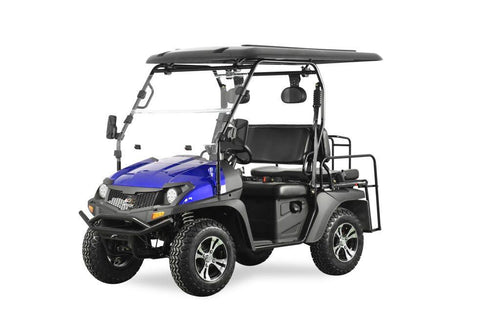
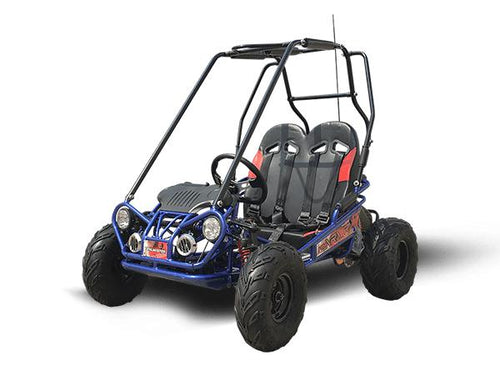
All three are off-road machines, and all three are priced for what they are. Our warehouse is in Garland, Texas, and they arrive crated with owner assembly on most models — wheels, windshield, seats and battery are the usual items. If you want the machine put together before it leaves us, we offer an assembly service; call 877-667-6289 and ask what it covers for the model you are looking at.


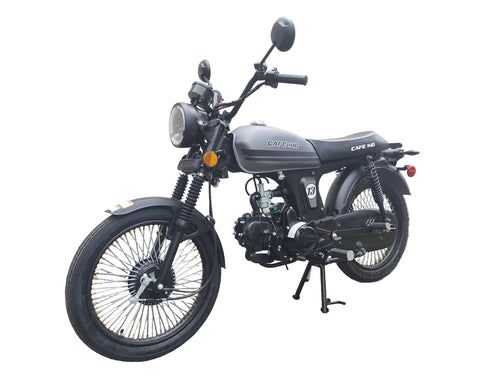
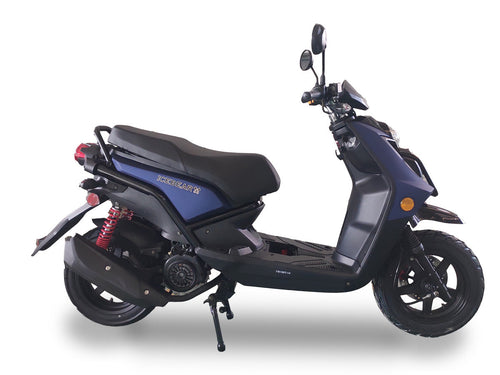
More four-wheeled machines: UTVs and side-by-sides, go-karts, and mini jeeps. If you came here from the two-wheel side, what makes a dirt bike road legal runs the same argument for motorcycles, where the certification labels are easier to find. For what these machines cost across the range, see our UTV price guide.
Common questions
Are UTVs street legal?
Not as they come. A side-by-side is built and certified as an off-road machine, so it carries no federal motor-vehicle certification and no factory road-legal status. A number of states do have a registration path for off-highway vehicles on certain roads, and a few have none at all. Your state motor vehicle agency is the only place to get the current answer for where you live.
Are mini jeeps street legal?
The two mini jeeps we list say the answer in their own product titles: off road only, not street legal. Both have headlights, turn signals, a horn and a windshield, which is exactly why the question keeps coming up. Road equipment is not the same thing as road certification.
Are go-karts street legal?
An off-road go-kart is not built as a motor vehicle, so it starts from the same place a side-by-side does. Some states have a path for a four-wheeled machine that meets their equipment and speed rules; many do not extend it to karts at all. Check with your own state agency before you buy parts.
What cc is street legal without a license?
There is no federal engine-size number that makes a vehicle road legal. Engine size matters in some state rules for mopeds and scooters, but it is not what decides whether a four-wheeled off-road machine can be registered. Do not take a cc figure from any blog, including this one, and hand it to a DMV clerk.
Does “CA Legal” on a listing mean street legal?
No, and this one catches people out constantly. CA Legal refers to California Air Resources Board approval, and CARB is an emissions authority — the note is about the engine’s emissions certification. It says nothing about whether the machine can be driven on a road. If California rules matter to your purchase, ask the California agency that handles the question.
Can I make my side-by-side street legal myself?
In some states, yes, with the right equipment and a trip through the registration process. In others there is no path regardless of what you bolt on. The one thing that is true everywhere: start with the paperwork question, not the parts catalog, because the parts are useless if your state will not title the machine for road use.
Do I need a license and insurance to drive one on the road?
Where a road path exists, it normally comes with license, registration and insurance requirements attached, and often with limits on which roads and what time of day. Those conditions are written by each state, so ask yours rather than assuming the rules from a neighboring state carry over.