RPS Motorcycles: Which RPS Street Bike Should You Choose?
- on March 07, 2023
- Categories: Articles
RPS — Ricky Power Sports — builds a compact range of street and dual sport bikes running from a $949 140cc automatic cafe racer up to a fuel-injected 300 that will hold highway speed. Picking between them comes down to three questions: do you want to shift gears, how much engine do you need, and what does your state require to put a plate on it?
The RPS street and dual sport lineup
Every bike below is a current model. Prices move with promotions, so treat them as a guide to where each machine sits in the range rather than a quote.
| Model | Engine | Transmission | Seat height | Best for |
|---|---|---|---|---|
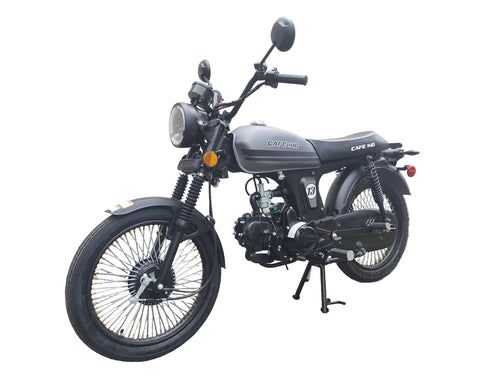
| Cafe 140 | 140cc air-cooled | 2-speed automatic | 29.9 in | First bike, short around-town trips |
| Condor 150 | 150cc air-cooled | 5-speed manual | 31 in | Learning a clutch on a small bike |
| M16 150 | 149cc air-cooled | Automatic, belt drive | 35.4 in | Mini-bike styling without a clutch |
| Hawk 250 | 229cc air-cooled | 5-speed manual | Tall | Dirt and pavement on a budget |
| Hawk-X 250 | 223cc air-cooled | 5-speed manual | 35 in | Taller riders, upgraded suspension |
| Cruiser 300 EFI | 305.5cc water-cooled | 6-speed manual | 29.1 in | Commuting, highway-capable road bike |
| Cross Country 300 | 305.5cc water-cooled | Manual | 34 in | Dual sport with real highway power |
Decide on automatic or manual first
This narrows the list faster than anything else. The Cafe 140 and the M16 150 are twist-and-go: no clutch lever, no shifting, nothing to stall in a parking lot. The Condor, both Hawks and both 300s use a hand clutch and a foot shifter.
If you expect to move up to a larger motorcycle later, learn the clutch on the smallest, cheapest bike you can — a 150 you can pick up yourself is a better classroom than a full-size machine. If this is a short-hop commuter that several people in the house will ride, take the automatic.
How much engine you actually need
140cc to 150cc: neighborhoods and side streets
The Cafe 140 makes roughly 10 hp with a listed top speed near 56 mph. The Condor 150 is the same size class but with five gears, dual disc brakes and a 31-inch seat — RPS positions it as a Honda Grom tribute at well under Grom money. Both are happy on 35 to 45 mph roads. Neither is a highway bike.
223cc to 229cc: the Hawk dual sports
The Hawk 250 and the taller Hawk-X 250 are the range's all-rounders: air-cooled singles, five speeds, hydraulic disc brakes front and rear, and a full DOT light package. They will cruise a back road and then get down a dirt road afterwards. They can keep up with 55 mph traffic, but they work for it, and the Hawk-X's 35-inch seat rules it out for shorter riders.
305.5cc: the 300 class
The Cruiser 300 EFI and Cross Country 300 share a water-cooled, balance-shaft engine with Bosch electronic fuel injection, listed at about 26.8 hp. Fuel injection is the real upgrade: it starts and runs predictably in cold weather and at altitude, where a carburetor needs fiddling. These are the only two in the range genuinely comfortable at sustained highway speed.
Street bike or dual sport?
The Cafe 140, Condor 150, M16 150 and Cruiser 300 are road bikes: lower seats, street tires, less suspension travel. The Hawk 250, Hawk-X 250 and Cross Country 300 are dual sports with taller seats, longer travel and knobbier tires. If you ride pavement with the occasional gravel driveway, take the road bike. If you have property to ride and a road to get there on, the dual sport is the honest choice, and a close cousin of a true enduro.
Licensing, registration and emissions
Motorcycle licensing, endorsements and what counts as street legal are set by your state, and the rules differ meaningfully from one to the next. Check with your own DMV before you order, and ask specifically about titling a bike bought online from a dealer.
What to check before the first ride
- •RPS bikes arrive largely assembled — typically the front wheel, handlebars and mirrors are left for you or your mechanic.
- •Go around every fastener with a torque wrench first, especially axle, triple clamp and brake caliper bolts.
- •Check tire pressure, chain slack and brake feel. Chains on a new bike stretch quickly in the first few hundred miles.
- •Change the oil early. Break-in oil catches assembly debris, and an early change is cheap insurance on an air-cooled single.
- •Budget for a helmet and gear at the same time you budget for the bike.
An honest framing: these are value-tier motorcycles. They are dependable when you do the setup properly and keep up with maintenance, and they cost a fraction of a Japanese equivalent. If you want a machine you never touch between dealer services, a used name-brand bike may suit you better.
Four to start with


Frequently asked questions
Who makes RPS motorcycles?
RPS stands for Ricky Power Sports, which specs and imports the machines and sells them through US powersports dealers. Motobuys is one of those dealers, and parts are ordered through the same channel.
Are RPS street bikes street legal?
Models with a full DOT light package are sold for road use, but titling and registration are state rules, and some models are not CARB approved, which matters in California. Confirm the exact model with your DMV before ordering.
What is the fastest RPS street bike?
The two 305.5cc machines. The Cruiser 300 EFI is listed at a maximum of 88 mph and the Cross Country 300 at 84 mph. Real-world speed depends on rider weight, gearing and conditions.
Is the Condor 150 a good first motorcycle?
It is one of the better choices in the range for a rider learning a clutch: a 31-inch seat, five gears, front and rear disc brakes and low enough weight to handle at walking pace.
Does RPS make dirt bikes too?
Yes. The off-road side of the range includes the Blade 250 and the full-size MX Viper 150, which are off-road only, plus smaller kids' models. The Hawk dual sports are the bikes that bridge dirt and street.