Best Go Karts for Kids: How To Compare Your Shortlist
- on March 07, 2023
- Categories: Articles
There is no single best go kart for kids, because a kart that fits a six-year-old is the wrong machine for a twelve-year-old. What works is a method: narrow to three karts on age, terrain and budget, then compare those three on the same seven specs. This guide is that method, worked through on karts we actually stock.
Ranked top-five lists are the wrong tool here. They compare karts that were never competing for the same rider, and they rank on features rather than fit. Do the shortlisting first.
Step 1: narrow to three karts
- •Rider size. Use the seat-to-pedal range, not the age label. If the published range does not cover your child's reach, nothing else on the spec sheet matters.
- •Terrain. Driveway and flat yard, or trails and rough ground? That decides tire size, ground clearance and whether you need real A-arm suspension.
- •Seats. One or two. Two-seaters are heavier and wider and cost more, but siblings share.
- •Budget, landed. These ship crated by freight. Compare total delivered cost, not sticker price.
Three candidates is the right number. More than that and you start comparing on trivia.
Step 2: the seven specs to compare
Put your three karts in a row and fill in these seven fields from the manufacturer spec sheet. Anything a maker will not publish is worth a question.
- •Frame and guarding — welded steel tube, belly guard, side rails, padded cage.
- •Brakes — hydraulic disc beats mechanical; front and rear beats rear only.
- •Restraint — lap belt, four-point, or five-point harness. This is the biggest safety difference between karts at similar prices.
- •Speed control — a throttle limiter, a governor, a remote kill switch, or all three.
- •Drive type — centrifugal clutch, CVT torque converter, or electric. A CVT pulls better from a stop and usually comes with reverse.
- •Suspension — dual A-arm front with coil-overs, or nothing at all.
- •Tire size and max load — bigger tires clear rough ground; published max load is a real limit.
Step 3: a worked comparison
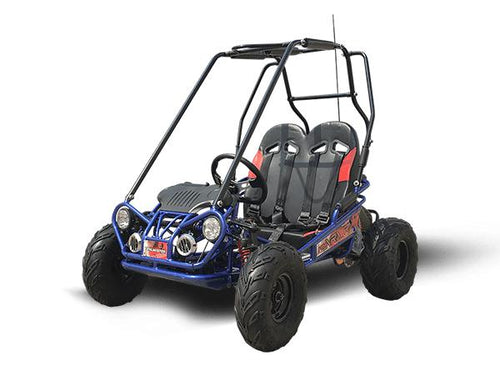
Here are six live youth karts laid out the same way. Note how differently they are specified at prices only a few hundred dollars apart.
| Kart | Power | Maker's age guide | Restraint | Speed control | Max load |
|---|---|---|---|---|---|
| Cheetah i3 | 500W electric | 6–10 | Lap belt | 3 speed settings, 10 mph top | 180 lb |
| Mini XRS+ | 163cc pull start | 5–11 | Lap belts | Throttle limiter, 12.4 mph | 400 lb |
| Tao GK110 | 110cc automatic | Youth | Belts | Governor, remote shut off | Not published |
| Spyder Mini 125 | 124cc automatic | 6–10 | Over-the-shoulder | Speed limiter | 298 lb |
| Mini XRX/R+ | 212cc CVT | Up to ~10 | 5-point harness | Limiter, remote kill | 300 lb |
| Cheetah 6 | 163cc CVT | 6–12 | 4-point belts | Governor, remote kill | 180 lb |
Figures as published by each manufacturer on the product page. Age guides are the maker's fit recommendation, not a legal or safety standard.
Reading the table honestly
Three things stand out. The Mini XRS+ publishes a 400-pound max load against 180 pounds on the Cheetah 6 — if two children will ride together, that gap matters more than horsepower. The Cheetah i3 is the only electric here, and its 10 mph ceiling with a low setting near walking pace makes it the easiest to supervise, at the cost of range and a single seat. And the Mini XRX/R+ is the only kart on the list with a five-point harness.
Top speed is the number to trust least. It is measured on flat ground with a light rider, and every kart above can be limited well below it. What you are really comparing is how the speed is controlled: a mechanical throttle limiter you set with a screwdriver is harder for a child to defeat than a switch.
Where a spec sheet misleads
- •Age ranges are fit, not capability. A tall nine-year-old may be out of a “6–12” seat.
- •“Full suspension” varies enormously. Dual A-arm front with oil-damped coil-overs is not the same as a swing arm and a spring.
- •Pre-assembled is not assembled. A 95% pre-assembled kart still needs wheels, cage, seats, steering wheel and battery, plus a torque check.
- •Most youth karts are not CARB approved, so California buyers are limited to private land.
Karts worth shortlisting


If you want more background first
This guide is deliberately about comparing karts against each other. For the surrounding questions we have separate pieces: a parent's buying guide to kids karts and buggies covers sizing and first-time ownership, how to choose the best go kart for your rider works through matching a kart to a rider, and our honest look at TrailMaster karts covers the brand that dominates this class.
Frequently asked questions
What is the best go kart for a 4 year old?
Most gas karts do not fit a four-year-old, and none of the karts here are recommended that young. A single-seat electric kart with a low speed setting and an adjustable seat, ridden under supervision, is the realistic starting point.
What size go kart does a 12 year old need?
Usually a mid-size kart rather than a mini. Look for a seat-to-pedal range in the low-to-mid thirties of inches and a published max load that covers your rider. Mini karts are generally specified up to about age 10 or 11.
How fast should a kids go kart go?
Slower than the machine can manage. Start a new rider at walking pace and raise the limiter as skills improve. Karts that cap at 10 to 12 mph are appropriate for young beginners.
Are electric kids go karts any good?
Yes, for young riders on flat ground. They are quiet, have no fuel or carburetor upkeep, and their speed settings are simple. The trade-offs are limited range, recharge time and usually a single seat.
What safety gear does a child need?
A DOT or motorsport helmet that fits, eye protection, gloves, long sleeves and over-the-ankle boots — plus an adult present, and a riding area with no traffic and no drop-offs.