200-300cc Go-Kart vs. UTV: What Actually Differs
- on April 03, 2024
- Categories: Articles
At 200–300cc, a go-kart and a UTV often share the same engine. What separates them is the body around it: a kart or buggy is a low, light two-seat frame built for speed and tight trails, while a UTV sits higher on a longer chassis with more seats, a bed and a load rating. Karts here are listed at roughly 31–38 mph, recreation UTVs at 35–45 mph, utility UTVs nearer 25 mph.
Go-kart, buggy, side-by-side: what the words mean
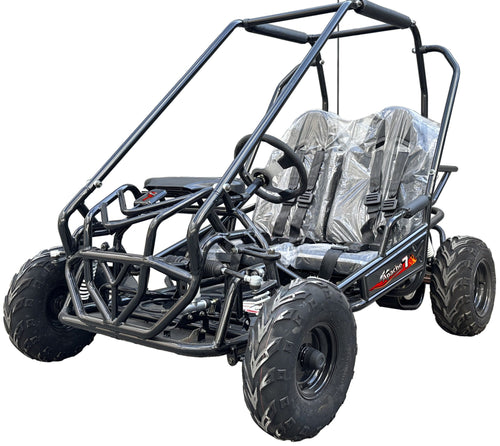
An off-road go-kart is a low-slung four-wheeler with a roll cage, a rear-mounted engine and one or two seats. Sellers call the larger, longer-travel versions buggies or sand rails — the same machine with more suspension and taller bodywork. A UTV, or utility task vehicle, is what most people mean by side-by-side: a taller cab with bucket seats, a steering wheel, usually a cargo bed, and often four seats.
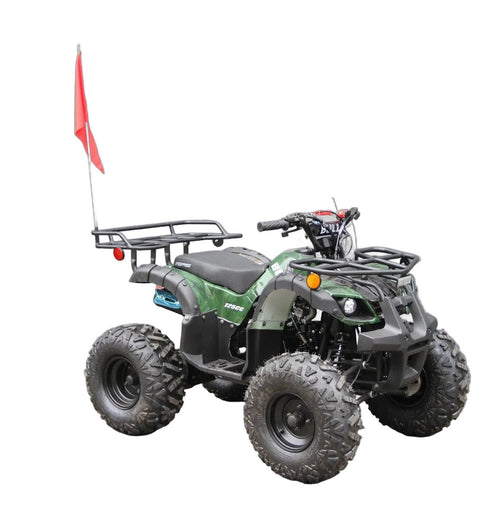
A go-kart is not an ATV. An ATV is the straddle-seat quad you ride like a motorcycle, with handlebars and a thumb throttle. Karts and UTVs both seat you in a cage with a wheel and pedals. If you are weighing the quad against the cab, see UTV vs. ATV explained.
How fast is a 200–300cc go-kart or UTV?
Here are the manufacturer figures from machines we stock, so you can see how the classes line up rather than guessing from displacement.
| Model | Type | Engine | Listed top speed | Ground clearance | Max load |
|---|---|---|---|---|---|
| TrailMaster Blazer 200R | Youth go-kart | 200cc air-cooled | 31 mph | 2.8 in | 400 lb |
| TrailMaster Cheetah 200X | Go-kart / buggy | 169cc air-cooled | 38 mph | 5.9 in | 500 lb |
| TrailMaster Cheetah 300E | Go-kart / buggy | 275.6cc water-cooled EFI | 38 mph | 5.9 in | 500 lb |
| TrailMaster Challenger 200 | Recreation UTV | 168.9cc air-cooled | 35 mph | 6.3 in | 500 lb |
| TrailMaster Challenger 300E EFI | Recreation UTV | 300cc water-cooled | 45 mph | 6.3 in | 500 lb |
| TrailMaster Taurus 200GX | Utility UTV | 177.3cc air/oil-cooled | 25 mph | 11.5 in | 800 lb |
Manufacturer figures on level ground. Rider weight, tires, terrain and a loaded bed all reduce real-world speed. TrailMaster is a brand of BV Powersports, a US company that specs the machines and sells them through authorized dealers; we are one of them.
Displacement alone does not set top speed: a 275.6cc kart and a 169cc kart are both listed at 38 mph, because gearing and weight matter as much as engine size. And the utility UTV is deliberately the slowest machine here — it is geared to pull and haul.
Engine and drivetrain
Both classes run a single-cylinder four-stroke with an automatic CVT and reverse, so there is nothing to shift. Air-cooled 169–200cc engines are the cheapest and simplest; 275–300cc water-cooled units with fuel injection start better in the cold and hold power on long hills. Most drive the rear wheels by chain, while heavier utility UTVs use shaft drive, which is cleaner and needs less attention.
Suspension, seating and terrain
This is the real split. Karts sit low with short travel and small tires, which makes them quick and stable on packed dirt, gravel and property trails, and punishing on rocks and ruts. A budget youth kart has under three inches of clearance; a full-size buggy has closer to six. UTVs carry six inches or more, longer wheelbases and taller tires, so they ride better over rough ground and cross mud that would beach a kart.
Seating follows from that. Karts seat one or two. UTVs come in two- and four-seat versions and usually add a cargo bed and a hitch, so they carry feed, tools, firewood or coolers as well as people. A kart has essentially no cargo space.
Safety, price and upkeep
Both ship with a full roll cage, belts or harnesses and hydraulic disc brakes. UTVs generally feel safer because they are heavier, wider and slower to change direction, but the biggest variable is how the machine is driven and whether riders wear helmets. Size it to the rider — youth karts are speed-limited for a reason.
On price, expect a full-size 200cc kart in the mid $2,000s to around $3,000, a 300cc EFI buggy at $4,000–$5,000, a two-seat recreation UTV from about $3,300, and utility UTVs from roughly $5,900. Upkeep is similar: chain, air filter, oil, tires, fasteners. Karts take more knocks; UTVs have more to grease. Our go-kart maintenance guide covers the schedule.
Machines in this class

Trailmaster Cheetah 200X Off Road UTV / Go Kart / Full size Youth and Adults
169cc kart / buggy · 38 mph listed
$3,399$3,649
View
Trailmaster Eagle 300XRSE EFI Ultra Buggy Go Kart Largest Engine
275.6cc EFI buggy · water-cooled
$4,199$4,399
View
Trailmaster Challenger 200 (2 Seater) 169cc UTV Live Rear Axle
169cc two-seat UTV · 35 mph listed
$3,299$3,599
View
Trailmaster Challenger 300E EFI (2 Seater) UTV / side-by-side
300cc UTV · 45 mph listed
$4,899$5,299
ViewWhich should you buy?
- •A go-kart or buggy if the point is recreation on your own land or dirt trails, you carry nothing but a passenger, and you want the most speed per dollar.
- •A recreation UTV if you take three or four people out, cross rougher ground, and want a bed for gear.
- •A utility UTV if the machine has a job. Accept 25 mph as the trade for an 800 lb load rating and 11 inches of clearance.
- •An ATV instead if you ride trails too narrow for a cage, or you would rather ride than drive.
Frequently asked questions
How fast does a 300cc go-kart go?
The 300cc-class karts and buggies we stock are listed around 38 mph, and 300cc recreation UTVs at up to 45 mph. Those are manufacturer figures on flat ground; loaded and on rough terrain, expect less.
How fast can a UTV go?
In the 200–300cc class, roughly 25 to 45 mph depending on what it is built for. Recreation models are quickest; utility models are geared for hauling and top out nearer 25 mph.
Is a go-kart an ATV?
No. An ATV is a straddle-seat quad with handlebars. A go-kart has a seat, a steering wheel, pedals and a roll cage.
Is a side-by-side the same as a go-kart?
Side-by-side usually means a UTV. Some two-seat karts are marketed as side-by-sides because the seats sit next to each other, so read the specs — clearance, load rating, whether there is a bed — rather than the label.
Which is cheaper to maintain, a kart or a UTV?
They are close. Both need chain or driveline attention, air filter, oil, tires and fastener checks. Karts get ridden harder; UTVs have more grease points and heavier parts.