How to Choose the Best Go Kart for Your Rider
- on December 10, 2020
- Categories: Articles
The best go-kart is the one sized to the person driving it. A kart that is too quick for a nine-year-old and a kart that is too small for an adult both end up parked in the shed. Work down the list in order: who drives it, gas or electric, one seat or two, and then the build details that separate a kart worth owning from one that is not.
The go-kart ladder
Off-road karts sort themselves into five broad classes. Prices below are where each class generally sits; individual models move with promotions.
| Class | Typical ages | Engine | Typical price | What defines it |
|---|---|---|---|---|
| Kids mini kart | About 5 to 10 | Electric or 110-212cc | $900 to $1,600 | Throttle limiter, remote kill, adjustable pedals |
| Mid-size | About 10 to 14 | 163-212cc | $1,700 to $2,700 | Full cage, reverse, higher seats, real suspension |
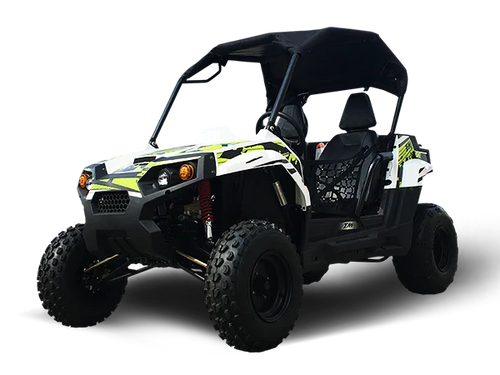
| Full-size youth and adult | 13 and up | 169-200cc, EFI options | $2,900 to $4,300 | Two seats, harnesses, lights, bigger tires |
| Big-bore adult | Adult | 300cc EFI, water-cooled | $4,200 to $7,000 | Most suspension travel, most torque, heaviest frame |
| Four-seat family | Mixed | 200cc EFI | Around $4,300 | Carries two adults and two kids on a trail |
Age ranges are shorthand for size. The test that matters: with their back against the seat, can the driver press the pedal flat and reach the wheel without leaning? If not, the kart is too big, whatever the listing says. For younger drivers our guide to kids buggies and go-karts goes through fit in more detail.
Gas or electric
Electric karts are quiet enough to ride near neighbors, have no carburetor to gum up between rides and cost cents to charge — but they recharge overnight rather than in two minutes. Gas karts ride all day, refuel from a can and give you more machine per dollar at the same size. Short sessions near the house favor electric; a full day on the trail still favors gas.
One seat or two
Two-seat karts dominate the mid-size and full-size classes for good reasons: an adult can ride along while a new driver learns, and a passenger seat makes the kart useful to the rest of the household. The costs are weight, a bigger engine to move it and a higher price. A single-seat kart is lighter, cheaper and simpler, and it removes the temptation for a new young driver to carry friends before they are ready.
What separates a good kart from a bad one
- •Frame. A welded steel tube chassis with a full roll cage and side rails, not a single hoop behind the seat. A belly guard matters as soon as there are rocks.
- •Brakes. Hydraulic disc. Band brakes on the cheapest karts fade quickly and are hard to adjust evenly.
- •Drivetrain. A torque converter or CVT with reverse. A plain centrifugal clutch is fine on a small kids' kart and struggles on hills with weight aboard.
- •Suspension. Dual A-arm front with coil-over shocks. Karts with no suspension punish the driver and eventually crack the frame.
- •Restraints. A 4- or 5-point harness anchored to the frame, not a lap belt bolted through sheet metal.
- •Adjustability. Seats and pedals that move. That is what makes one kart last a child three or four years.
- •Fuel system. Electronic fuel injection on the larger machines. It starts in the cold and does not need rejetting at altitude.
- •Parts and support. Buy a brand with a real parts department behind it. TrailMaster, for example, is the brand of BV Powersports, which specs the machines and runs its own parts operation through authorized US dealers.
Assembly is part of the purchase
Most karts arrive in a crate needing wheels, the cage, the steering wheel and a fluids check — call it two to four hours with basic tools. Several models are also sold roughly 95 percent pre-assembled for a modest premium, and if you do not enjoy wrenching that premium is the cheapest part of the decision.
A note on top speed
Top speed is the number buyers ask about first and the one that tells you least. Published figures are measured with a light driver on flat, firm ground; gearing, tire size, rider weight and terrain all move the real number. A 300cc kart's advantage over a 200 shows up mostly as torque climbing a hill with two people aboard. Check the specific listing, and judge the kart on its brakes, suspension and frame first.
One kart from each rung

Trailmaster Eagle Mini XRX/R+ Go Kart with Reverse Best Seller. Up to 10 years Old
Kids size, 212cc, remote kill, reverse
$1,549$1,849
View
TRAILMASTER Eagle Mid XRX/R - With Reverse
Mid-size, 212cc, full suspension, reverse
$2,299$2,759
View

TRAILMASTER Eagle 300XRX-E (EFI) Buggy / Go Kart Water Cooled
300cc EFI, water-cooled, hybrid shaft drive
$4,799$4,999
ViewShopping specifically for a child? The honest look at TrailMaster karts for kids is the companion piece to this one.
Frequently asked questions
What is the best go-kart for a 10-year-old?
A mid-size kart in the 163cc to 212cc range with a throttle limiter, reverse and a full roll cage. Fit comes first: they should reach the pedal flat with their back against the seat.
How fast do go-karts go?
Kids karts are typically limited to between 5 and 15 mph, mid-size karts run in the high teens to mid-twenties, and full-size adult karts go higher. Published top speeds assume a light driver on flat ground.
Are two-seat go-karts worth the extra cost?
For most families, yes. A passenger seat lets an adult ride along while a new driver learns, and it keeps the kart useful to more of the household.
What is the best compact go-kart for limited space?
Kids and mid-size karts are roughly five to six feet long and fit a standard garage bay alongside a car. Check the crate dimensions before delivery, as the crate is larger than the kart.
Gas or electric for a first go-kart?
Electric for a young child riding near the house: quiet, no pull-start, no fuel. Gas for longer sessions and for anyone riding away from a power outlet.