Your Guide To Typical Moped Gas Mileages
- on May 30, 2024
- Categories: Articles
Most 49–50cc mopeds return roughly 90 to 120 MPG. Step up to a 150cc scooter and it drops to about 65–85 MPG. With tanks of only 1–1.5 gallons, that works out to a practical range of around 100–150 miles — efficient, but not built for distance.
Fuel economy is the reason most people start looking at a moped, and it is one of the few areas where the marketing is not exaggerating. What the numbers do not tell you is how much your own riding changes them, which is usually more than the badge on the side.
Typical fuel economy by engine size
These are the ranges generally reported for this class of machine, not figures we have measured ourselves. Treat them as a planning guide rather than a specification.
| Engine size | Typical MPG | Typical top speed | What it suits |
|---|---|---|---|
| 49–50cc | 90–120 | 28–35 mph | Short local trips, campus, errands |
| 125cc | 80–100 | 50–60 mph | Suburban roads, longer commutes |
| 150cc | 65–85 | 55–65 mph | Keeping up with town traffic |
| 250cc | 55–75 | 70+ mph | Highway-capable riding |
The pattern is consistent: every step up in displacement costs you mileage and buys you speed and road access. There is no size that gives you both.
Range is limited by the tank, not the MPG
This is the part people get wrong. A moped returning 110 MPG sounds like it will go forever, but the tank in this class holds around a gallon. Do the arithmetic and you land near 110–140 miles before you are looking for a gas station.
Five things that cost you mileage
- •Full-throttle riding. These engines are most efficient at part throttle. Pinning it costs more here, proportionally, than on a car.
- •Tire pressure. The single most ignored item and the cheapest to fix. Check it cold, monthly.
- •A dirty air filter. Cheap to replace, and neglected filters quietly cost several MPG.
- •Short cold trips. An engine that never reaches operating temperature runs rich the whole way.
- •Carrying weight. A 50cc engine notices a passenger or a loaded rack far more than a car does.
Carbureted or fuel injected?
Fuel injection generally returns slightly better economy and much better cold starting, because it meters fuel to conditions rather than to a fixed jet. A carburetor is cheaper to buy and something you can service yourself with basic tools. Neither is wrong — but if you ride in cold mornings, EFI earns its premium quickly.
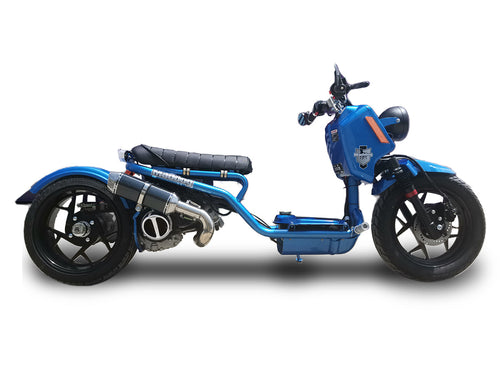
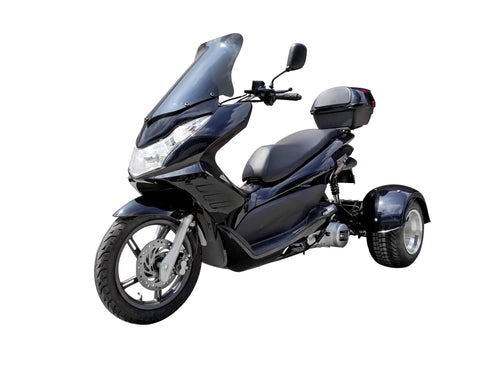
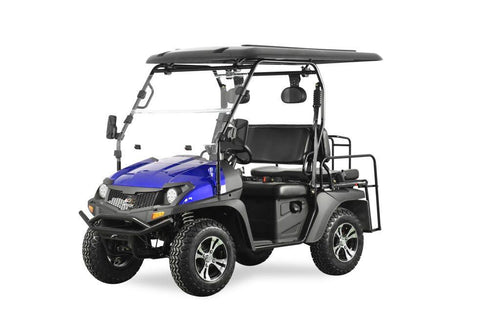
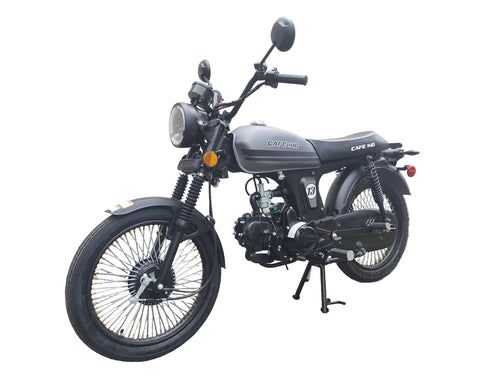
Three efficient scooters we keep in stock
All three are 49–50cc, fully automatic and electric start — the configuration that gets the mileage figures at the top of this page.


See the full range of scooters, mopeds and trikes. Questions about a specific model? Call 877-667-6289 — the phone goes to our Garland, Texas warehouse.
Frequently asked questions
What MPG does a moped get?
Most 49-50cc mopeds return somewhere between 90 and 120 MPG in ordinary use. Larger scooters give up mileage as displacement climbs: a 150cc typically lands in the 65-85 MPG range and a 250cc lower again.
How far can a moped go on a full tank?
Tank sizes in this class are small, usually around 1 to 1.5 gallons, so even at 100 MPG the practical range is roughly 100 to 150 miles. Mopeds are efficient rather than long-legged.
Do mopeds take regular gas?
Yes. Regular 87-octane pump gas is correct for almost every four-stroke moped and scooter in this class. Higher octane buys you nothing unless the manufacturer specifically calls for it.
Is a moped cheaper to run than a scooter?
Per mile, usually yes, because a smaller engine burns less. But the gap narrows once you factor in that a bigger scooter can keep up with traffic and take routes a moped legally cannot.
What hurts moped gas mileage most?
Riding at full throttle, under-inflated tires, a dirty air filter, and a lot of cold short trips. Of those, tire pressure is the one people ignore and the easiest to fix.
Not sure whether you want a moped or a larger scooter? Our moped vs scooter comparison covers the legal and practical differences. Or browse everything in scooters and mopeds.