A UTV for Work and Play: Choosing One Dual-Purpose Machine
- on May 04, 2023
- Categories: Articles
A side-by-side that has to do property work Monday through Friday and haul people around for fun on Saturday is a compromise machine, and the compromise is real. Recreation-first UTVs give up bed capacity and towing; utility-first UTVs give up suspension travel and speed. Buying well means deciding which side of the week you are willing to under-serve.
Why one machine cannot be best at both
The two jobs pull the design in opposite directions. Work wants a low, strong cargo bed, a hitch rated for a real load, a wide stable stance and gearing that pulls at walking pace. Recreation wants light weight, longer travel suspension, a higher top speed and a narrower body that fits between trees. Every dual-purpose UTV lands somewhere on that line, and no amount of marketing moves it.
TrailMaster splits its range along exactly this line: Challenger vs Taurus. Challenger is the recreation family, starting around $3,300, and Taurus is the utility family, starting around $5,900. That price gap is mostly bed, frame and drivetrain — the parts that do work.
| Recreation-first | Utility-first | |
|---|---|---|
| Cargo | Small rear tray, light loads | Real bed, often with a dump function |
| Towing | Light or none | Rated hitch for a trailer or implement |
| Suspension | Longer travel, softer over bumps | Stiffer, built for loaded weight |
| Gearing | Geared for speed | Often high/low range for pulling |
| Body width | Narrower, better on tight trails | Wider, more stable under load |
| Best week | Weekends win, chores are adequate | Chores win, weekends are adequate |
Start from the weekday list, not the weekend one
Recreation requirements are vague — fun, trails, taking the kids out. Work requirements are measurable, so start there and let them set the floor. Write down honestly:
- •The heaviest thing you will carry. Feed sacks, firewood, fence posts, a generator. That number sets the bed you need.
- •Whether you will tow. If yes, you need a rated hitch and low-range gearing, and that pushes you into the utility family.
- •The narrowest gate, gap or trail. Measure it. Machine width is the one spec that flatly rules models in or out.
- •Where it sleeps. Shed, barn, garage bay — measure the door and the depth before you fall for a four-seat model.
- •How many seats you actually need at once. Two seats plus a bed is a different machine from four seats plus a small tray.
The five specs that decide dual use
Once the list above exists, these are the specs to compare. Everything else is preference.
- •Bed capacity and whether it dumps. A dump bed turns a two-person mulch job into a one-person job. It is the single feature owners miss most when they skip it.
- •Hitch rating. A receiver on the back is not the same as a towing rating. Check the number, not the hardware.
- •Overall width. Narrow gets down trails; wide is steadier on side slopes with a load. You cannot have both.
- •2WD versus 4WD with high and low range. On dry, flat property 2WD is genuinely enough. Mud, wet grass on a grade, or pulling a loaded trailer is where 4WD and low range stop being optional.
- •Seat count. Four seats add length and weight and usually shrink the bed. Add them only if people will actually be in them.
Where the compromise usually lands
For most buyers the honest answer is to pick the side of the week you use more and accept the other is adequate rather than excellent. A recreation UTV hauls firewood; it just takes two trips. A utility UTV takes the family up a trail; it just rides firmer.
The one case where that rule breaks is heavy, regular work — daily loads, real towing, steep or muddy ground. There, buy the utility machine and let the fun be a bonus, because a recreation chassis worked hard will wear out its suspension and drivetrain first. If that describes you, our best UTV for farm work guide goes deeper on the work side.
Four machines across the work-play spread

TrailMaster Challenger 200EX EFI (2 Seater) UTV Deluxe
Recreation-first two-seater, EFI
$4,599$5,519
View
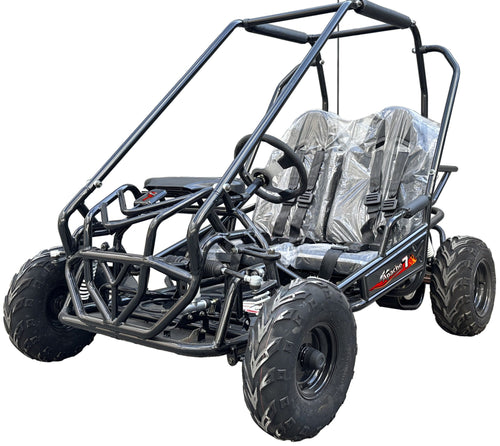
TrailMaster Challenger 4-300 EFI (4 Seater)
Four seats, recreation bias, fuel injected
$5,799$6,199
View

Trailmaster Taurus 450-U UTV High/Low Gear- 4 wheel Drive (2 Seater)
4WD with high and low range for real work
$8,699$10,439
ViewIf you are still weighing whether a side-by-side is the right vehicle at all, start with what a UTV is and UTV vs ATV. For budgeting, the side-by-side price guide lays out what each tier buys, and whether a side-by-side is worth it covers ownership honestly.
The costs people forget
A dual-use machine gets more hours than a pure toy, and running costs follow. Budget for tires that wear faster under load, more frequent oil changes, and a battery tender if it sits between seasons. If you will trailer it as well as use it at home, check the loaded weight against your trailer and tow vehicle before you buy.
Frequently asked questions
Can one UTV really do both work and recreation?
Yes, but not equally well. Every side-by-side is designed with a bias toward either cargo and towing or suspension and speed. Choose the bias that matches the use you get more of, and treat the other as adequate.
Do I need 4WD for property work?
Not always. On dry, mostly flat ground, 2WD handles chores fine and costs less. Mud, wet grass on a slope, or towing a loaded trailer is where four-wheel drive with a low range earns its price.
Is a dump bed worth the extra cost?
For anyone moving mulch, gravel, feed or firewood regularly, it is the feature owners say they would not give up. If your loads are occasional and light, a fixed tray is enough.
How wide a UTV can I buy?
Measure your narrowest gate, barn door and trail first, then shop within that number. Width is the spec that rules machines out fastest, and it cannot be changed after purchase.
Two seats or four?
Four seats add length and weight and usually reduce cargo space. Buy them only if you will regularly carry more than one passenger; otherwise a two-seater with a real bed is the more useful machine.