Go-Kart Maintenance: Low-Upkeep Karts and the Schedule
- on April 18, 2023
- Categories: Articles
The go-karts that need the least work over the years are the simple ones: fuel injection instead of a carburetor, a chain or belt drive you can actually reach, and a brand with a US parts supply behind it. After that, upkeep is a short list — chain or belt, air filter, oil, tires, brakes and fasteners — done on a schedule rather than after something breaks.
How to choose a go-kart with the lowest long-term maintenance
Most of your future maintenance is decided at purchase. These are the choices that matter, in the order they matter.
| Choice | Lower-upkeep option | Why it matters |
|---|---|---|
| Fuel system | EFI over a carburetor | Carburetors gum up on old fuel; EFI starts after storage and needs no jetting |
| Parts supply | A brand with a US parts department | A cheap kart with no parts channel is scrap the first time something breaks |
| Drive | Torque converter with an accessible chain | Belts and chains are consumables; what matters is whether you can reach them |
| Cooling | Air-cooled for simplicity, water-cooled for heat | Air-cooled has nothing to leak; water-cooled survives long hot runs better |
| Brakes | Hydraulic disc | Cable and drum setups need more frequent adjustment |
| Assembly | 95% assembled or dealer-built | Most early faults on budget karts trace to assembly, not parts |
Match the machine to the rider, too. A youth kart driven by an adult, or a kart run flat out on rocky ground every weekend, eats chains, tires and bearings far faster than the same machine used as intended. If you are still deciding between body styles, see our go-kart vs. UTV comparison.
Every ride: the five-minute check
- •Walk around and look for anything hanging, leaking or loose.
- •Check tire pressure with a gauge and look at the treads.
- •Check chain or belt tension and look for fraying.
- •Test the brakes at walking pace before you open it up.
- •Check the oil level, and top up with fresh fuel.
Chain, belt and torque converter
Most budget karts drive through a torque converter — a variable belt system — and then a chain to the axle. Both wear. Inspect the belt for fraying, glazing and cracks and replace it at the first sign; it costs a fraction of the damage a snapped one causes, and it is the part most likely to strand you. Keep the chain clean, lubricated and adjusted to the slack in your manual, and replace chain and sprockets as a set once the teeth hook. Use the sizes listed in your manual, since converters vary between models.
Go-kart tire care
Tires take the worst of off-road use and are the cheapest thing to get wrong. Check pressure cold before every outing with a gauge rather than by squeezing — small tires change a lot with a few psi. Off-road kart pressures usually fall in the 8–15 psi range, but your manual and the sidewall are the authority. Look for cuts, embedded gravel and torn knobs each time, watch the wear indicator lines, and keep the lug nuts tight, since alloy rims lose torque as they settle.
Match the tire to the ground: knobby dirt tires last longest off-road, all-terrain tires are the compromise for mixed use, and soft compounds are for prepared tracks and wear out quickly anywhere else.
Air filter, oil and spark plug
Check the air filter every time you change the oil and after any dusty session. Hold it up to a light; if you cannot see through it, clean or replace it. Follow the manual for oil, but plan on checking the level monthly, changing it roughly every 10 to 20 running hours, and changing the break-in oil early on a new kart. Look at the spark plug and fuel lines at the same interval — plugs are consumables, and cracked fuel line is a fire risk.
Brakes, bearings and fasteners
Vibration is what loosens a go-kart. Go around it with a wrench every few outings — wheel nuts, seat mounts, cage bolts, engine mounts, steering and tie rod hardware — and more often on rough ground. Grease the chassis and wheel bearings every few months. Check pad thickness and pedal feel monthly; a pedal that travels further than it used to means pads, air or fluid, and it gets fixed before the next ride.
Storage and the off-season
Before a kart sits for months: wash and dry it, change the oil, lube the chain and chassis, either drain the fuel or add stabilizer and run the engine long enough to reach the carburetor, remove or tender the battery, take weight off the tires, and cover it against rodents. Nearly every spring no-start traces back to fuel left in a carburetor. Buggy owners have extra jobs — longer-travel suspension and CV joints — covered in dune buggy maintenance.
Karts we stock


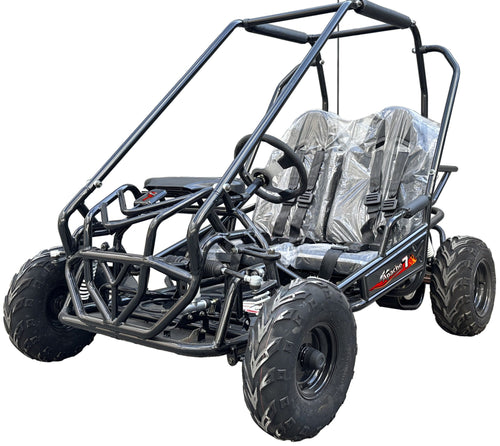
Trailmaster Cheetah 200X Off Road UTV / Go Kart / Full size Youth and Adults
169cc · full-size two-seat
$3,399$3,649
View
Trailmaster Cheetah 300E Off Road UTV/Go kart 18 HP Fuel Injected
275.6cc EFI · water-cooled
$4,399$4,699
View
Trailmaster Eagle 300XRSE EFI Ultra Buggy Go Kart Largest Engine
275.6cc EFI buggy · largest engine
$4,199$4,399
ViewTrailMaster is a brand of BV Powersports, a US company — BV stands for Best Value. It runs its own parts department, which is the practical reason these are easier to keep running than an unbranded import.
Frequently asked questions
Which go-karts need the least maintenance?
Look for fuel injection rather than a carburetor, hydraulic disc brakes, an accessible chain or belt, and a brand with a US parts department. Buying one that arrives assembled removes the most common source of early faults.
What maintenance keeps go-kart tires in good shape?
Check pressure cold with a gauge before every outing, usually in the 8 to 15 psi range but confirm with your manual. Look for cuts and torn knobs, keep lug nuts tight, watch the wear lines, and match tire type to the ground you ride.
How often should I change go-kart oil?
Follow the manual. In practice, check the level monthly and change the oil roughly every 10 to 20 running hours, plus an early change after break-in on a new kart.
How do I store a go-kart for winter?
Wash and dry it, change the oil, lube the chain and chassis, stabilize or drain the fuel, remove or tender the battery, take weight off the tires and cover it. Fuel left in a carburetor is the most common cause of a spring no-start.
How often should the chain and belt be checked?
Every ride or two. Adjust chain slack to the manual's figure, keep it clean and lubricated, and replace a drive belt as soon as it frays or glazes rather than waiting for it to break.